
Four Questions About the Games Our Children Play
An evening with parents in Albino about video games, online interactions, spending, and FOMO, with four practical questions to take home and discuss together.
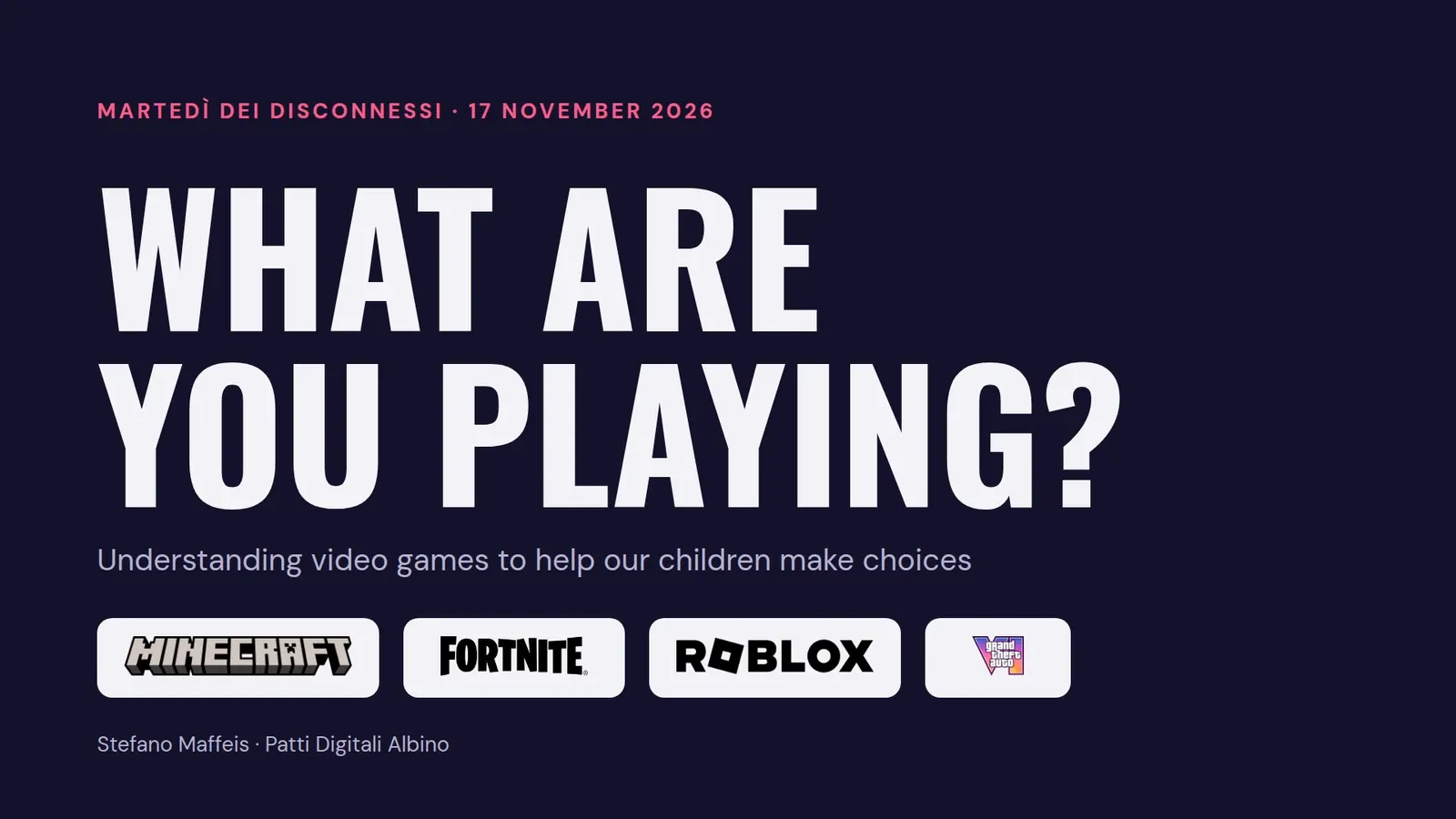
On 17 November, I gave a talk about video games to a few dozen parents in Albino, the town where I live. Several times during the evening, parents interrupted to ask questions, offer their own examples, or go further into something I had only touched on. Those exchanges are a large part of why I came away feeling the evening had gone well.
I am part of our local Patti Digitali group. The wider Patti Digitali network brings communities together around more conscious use of digital technology, particularly where children are concerned. In Albino, we organize evenings to share information and discuss the choices we face as parents.
About a year ago, video games came up during one of those conversations. We realized how little some of us knew about what our children were playing, and I was asked to prepare a presentation. Several months passed before the topic came back and we settled on a date.
By coincidence, it was two days before the announced release of Grand Theft Auto VI, on 19 November. With Santa Lucia and Christmas approaching, it seemed a useful moment to talk about what a request for a game, a console, or some virtual currency might involve.
Something parents could use the next day
I called the talk A cosa stai giocando?, or What are you playing?
I wanted to give parents a few things they could check when a child asked to download a game or receive one as a present. I am a programmer and a parent; I was not there to prescribe a universal starting age or a daily allowance of minutes.
I have already written about the parental controls I use at home. For this evening, I wanted to spend more time on understanding what we are choosing and configuring in the first place.
The presentation revolved around four questions:
- What are they playing?
- Who are they playing with?
- How does this game make money?
- Why does it want them to keep playing?
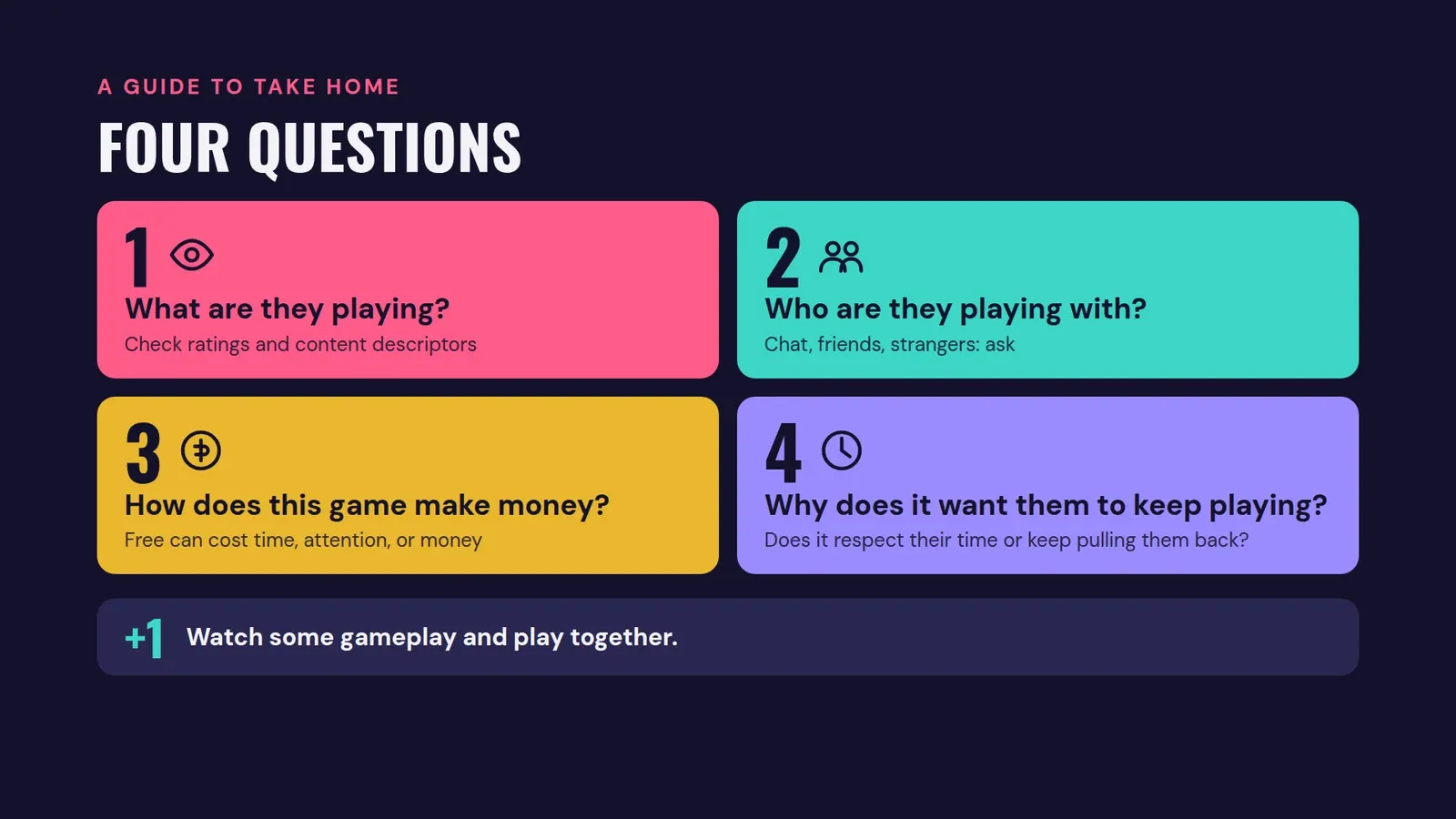
The first question gave us a way into age ratings and content descriptors. The second brought in chat, other players, and platforms such as Roblox, where knowing the name of the platform tells us very little about the particular experience a child is having.
The last two questions were where I particularly wanted to spend time. A game can ask for money, attention, or repeated visits in ways that are not immediately obvious to someone looking over a child’s shoulder.
Looking for a simple rule
One parent, who was less familiar with the subject, asked more than once whether offline games were outside the mechanisms I was describing.
That was a useful question to come back to. In the presentation, I had suggested that an offline game bought once, with no advertising or open chat, could be simpler to evaluate. Those features reduce the number of things we need to investigate. They do not, by themselves, settle whether a particular game is suitable for a particular child.
I wanted the four questions to help with that investigation. A parent should be able to use them without first becoming an expert in the whole industry.
The pressure to come back
We talked about virtual currencies, paid random rewards, and battle passes. One example was buying a pass for a reward that only unlocks after enough play, before the season ends. The purchase can leave a player feeling they have something to lose if they stop.
There are also daily rewards, streaks that disappear after a missed day, and events available for a limited time. These gave us a concrete way to discuss FOMO, the fear of missing out, and the commercial incentives behind some of the experiences our children enjoy.
At that point, another parent brought up Duolingo. They knew people who would reach the evening without having completed their daily exercise and feel they had to leave a social occasion and go home to do it, because otherwise they would lose their streak of consecutive days.
That example came from the audience. It took the discussion beyond video games and into a mechanism adults in the room could recognize in their own lives. The reason for opening the app might be learning a language, but preserving the streak can become a reason to open it too.
Making room for the positive side
When I showed a slide about a positive aspect, one parent expressed relief that there was something positive to say. They felt I had put a lot of emphasis on the risks.
That reaction belongs in this account too. My intention was to help people approach games with more understanding. The concerns were important, but so were the possibilities for enjoyment, creativity, and playing together. I had included those in the presentation; a parent still felt the balance had leaned heavily toward risk.
The room included people with quite different levels of familiarity. Some needed an introduction. Others could add examples or deepen points I had left fairly brief. The prepared slides gave us an order to follow, and the interruptions gave us opportunities to explore what people wanted to understand.
I came away feeling the evening had been a success. A few dozen parents came, and many of them contributed to the conversation.
From sticky notes to an HTML presentation
The preparation stretched over several months. I started with a Miro board, adding sticky notes for the subjects I wanted to cover. Then I discussed them with ChatGPT to put an initial outline in order.
For months after that, whenever I came across an interesting topic, a useful detail, or a news story, I added it to the same ChatGPT conversation. It became a running collection of material I could return to when I was ready to work on the talk.
About a month before the evening, I picked up that whole collection and started writing the spoken script myself. I wrote roughly a third of it. By then, the way I wanted to approach the conversation was clear enough that I could hand the notes and my draft to Claude.
Claude proposed a slide deck, and we started iterating. I supplied the ideas, the screenshots, and much of the final ordering of the slides. Claude handled the layout and supplied supporting sources where I had not already collected them along the way.
The result was an HTML presentation with a spoken script and speaker notes. The deck took shape through those iterations, starting from material I had gathered and a voice I had already begun to put on the page.
I also did a dry run for my family. My wife is a Toastmasters member and has experience giving speeches. She gave me a series of notes, which I incorporated into the final presentation.
Using HTML also meant I could leave the whole presentation online. Parents received the link during the evening and can go back to the examples and resources afterward. The original presentation and the talk are in Italian; the two slide images in this article have been adapted into English.
The preparation gave me something structured to bring into the room. I still needed to explain it, listen to how it landed, and follow the questions that came back. The comments about offline games, the balance of risks and benefits, and Duolingo were all contributions from the parents who were there.
Asking to be shown
The practical invitation at the end of the talk was to sit down with our children and ask them to show us what they are playing.
Let them explain the rules, who they play with, what a particular currency buys, or why an event matters to them. Perhaps try a game together. We can learn something specific before deciding what to allow, what to configure, or what to buy.
With the gift-giving season approaching, that is something we can do before answering the next request for a game.
References
- A cosa stai giocando?, the presentation from the evening, in Italian.
- Patti Digitali, the community network.
- PEGI: In-Game Purchases, information about purchases and tools available to parents.
- Grand Theft Auto VI, Rockstar’s announced release date.
Share